
Thermal Guard
Junction Temperature Analysis
325°C
DANGER: OVERHEAT
Standard $T_{J(max)}$ for silicon is usually 125°C – 150°C.
If the temperature exceeds this, a heatsink is required.
If the temperature exceeds this, a heatsink is required.
Thermal management is modeled using an analogy to Ohm’s Law:
- Temperature Difference (ΔT) is like Voltage (V).
- Power Dissipation (P) is like Current (I).
- Thermal Resistance (Rθ) is like Electrical Resistance (R).
Core Formulas:
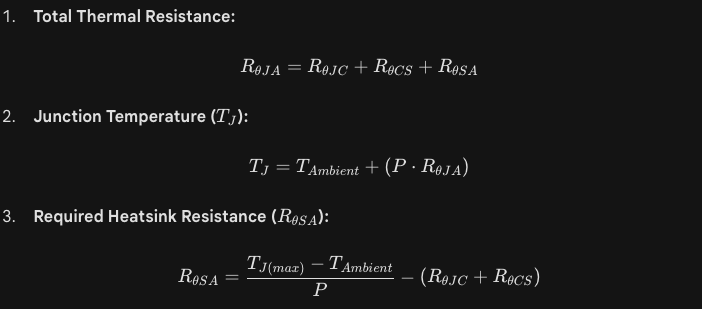
Thermal Interface Material (TIM): Never ignore the resistance between the component and the heatsink (RθCS). Using thermal paste can reduce this from ~2.0 °C/W to less than 0.2 °C/W.
Derating: For high reliability (military or industrial), engineers “derate” components, meaning they design for a maximum TJ of 100°C even if the datasheet says 150°C.
Natural vs. Forced Convection: If your required RθSA is too low to achieve with a standard heatsink, you must add a fan (Forced Convection). A fan can improve thermal performance by 2x to 10x.