
Volt Drop Master
Conductor Loss Analysis
1.8V
1.5% Loss
Rule of Thumb: NEC recommends keeping voltage drop under 3% for branch circuits and 5% for total systems.
Voltage drop occurs because every conductor has a small amount of internal resistance (R). As current (I) flows through the wire, some voltage is “consumed” by the wire itself according to Ohm’s Law.
The Core Formulas:

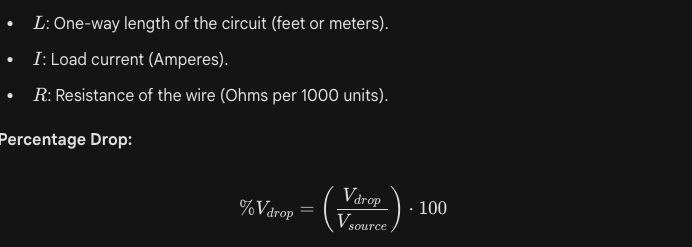
- 3% Limit: The National Electrical Code (NEC) suggests a maximum voltage drop of 3% for branch circuits to ensure appliances work correctly and don’t overheat.
- Material Matters: Copper has lower resistance than Aluminum. If you use Aluminum wire (common for main service feeders), you usually need to go two sizes larger (e.g., #2 Al instead of #4 Cu) to achieve the same voltage drop.
- Heat Dissipation: A circuit with a high voltage drop isn’t just inefficient—it’s dangerous. That lost voltage is turning into heat inside your walls. If the drop is too high, your wire insulation could melt.