
VOLTAGE DIVIDER
Voltage Divider Calculator
Output Voltage (Vout): 2.50 V
Understanding the Voltage Divider Circuit
A voltage divider is a fundamental passive circuit that produces an output voltage (Vout) that is a fraction of its input voltage (Vin). It is widely used in level shifting, sensor interfacing, and creating reference voltages.
The Voltage Divider Equation
The relationship between the components is governed by Ohm’s Law. The formula to calculate the output voltage is:
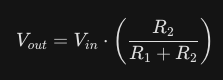
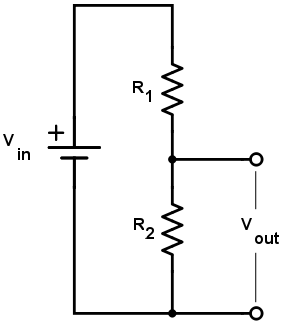
Where:
- Vin: Source voltage.
- R1: Resistor connected to the input voltage.
- R2: Resistor connected to the ground.
- Vout: The dropped voltage measured across R2.
Common Applications in Electronics
- ADC Inputs: Scaling a high battery voltage (e.g., 12V) down to a safe range for a microcontroller (e.g., 3.3V).
- Level Shifting: Converting 5V logic signals to 3.3V signals to protect sensitive ESP32 or STM32 pins.
- Potentiometers: A volume knob is essentially a variable voltage divider.
Important Note: Voltage dividers are not suitable for powering high-current loads (like motors or LEDs) because the voltage will drop significantly when a load is connected. For power regulation, use a dedicated LDO or Buck Converter.